Seam allowance and 1:1 templates: cutting at the right size
A quilt is only as accurate as its pieces. Two things decide it: the seam allowance you add when cutting, and the scale at which you print your templates.
The ¼ in seam allowance
Quilters sew with a ¼ in (0.6 cm) seam allowance. It is narrow enough to save fabric and lie flat, wide enough to hold. Every cut size in a pattern already includes it.
Many quilters sew a “scant” quarter inch, a thread or two narrower, because the fold of the pressed seam takes up a little fabric.
Rotary cutting or templates?
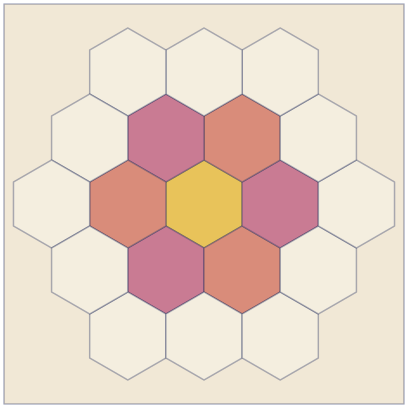
Squares, rectangles and most triangles are faster to cut with a rotary cutter and a ruler, from strips. Templates are useful for shapes that don’t fit a ruler: hexagons, 60° triangles, curves, unusual angles.
In a Quiltkit pattern, pieces that can be cut with a ruler are listed with their dimensions; the others get a 1:1 template.
Reading a template
- the solid line is the cutting line;
- the dashed line is the sewing line, ¼ in inside;
- the letter matches the cutting list, and the count tells you how many to cut.
Printing at 100%
In the print dialog, choose “Actual size” or 100%, never “Fit to page”. Before cutting anything, measure the 1 in test square printed on every template page: if it isn’t exactly 1 in (2.54 cm), check the printer settings and print again.
English paper piecing
For hexagons, the template without seam allowance is used to cut papers: the fabric is folded and basted around each paper, then the pieces are sewn by hand.